



Enterprise platform discussions often begin with software costs.
Licence fees, subscription models, implementation budgets, and support agreements are relatively easy to compare during procurement. They are visible, measurable, and usually well documented by vendors.
The challenge is that software costs represent only one part of a platform’s economic impact. Once a platform is embedded across teams, workflows, and business processes, a much broader set of costs begins to influence its value.
Integrations need maintaining. Governance models need evolving. New channels emerge. Teams expand into new regions. Business priorities shift. Technologies that were not part of the original requirements become important.
Over time, these factors often have a greater influence on platform economics than the original software agreement.
This is why enterprise organisations increasingly evaluate platforms through the lens of total cost of ownership (TCO).
The largest platform costs often emerge after launch

Many digital platforms begin with a relatively clear set of requirements. A website needs to be rebuilt. A content platform needs modernising. Multiple properties need consolidating onto a shared foundation.
Those projects have a defined scope and budget.
The complexity arrives later.
As organisations grow, digital platforms become connected to a wider ecosystem of services. Content management systems frequently sit alongside customer data platforms, analytics tools, ecommerce services, identity providers, DAM systems, marketing automation platforms, translation workflows, and increasingly, AI-powered tools.
Each integration creates value. Each integration also introduces dependencies that require maintenance, governance, and operational oversight.
At enterprise scale, platform ownership becomes less about running a CMS and more about managing an evolving digital ecosystem.
Understanding how a platform supports that evolution is central to understanding its long-term cost profile, and thus the total cost of ownership.
Why platform flexibility has financial value
Enterprise requirements rarely remain static for long.
A business may acquire a new brand, expand into a new market, launch a new product line, or introduce entirely new customer experiences. Regulatory requirements change. Internal operating models evolve. New technologies create opportunities that were not anticipated when the platform was first selected.
Every one of these developments places demands on the underlying platform.
Some platforms accommodate change relatively easily. Others require significant redevelopment, specialist expertise, or commercial agreements before new capabilities can be introduced.
The difference has a direct financial impact.
When introducing a new integration takes months rather than weeks, costs increase. When teams are forced to work around platform limitations, productivity declines. When architectural decisions made years earlier restrict future options, innovation becomes slower and more expensive.
This is one reason enterprise leaders increasingly assess a platform’s adaptability alongside its feature set.
Understanding the economics of proprietary platforms
Proprietary platforms provide a clear commercial model. Organisations pay for access to software that is owned, developed, and governed by a vendor.
For many businesses, this structure offers reassurance. Product roadmaps, support models, and accountability are clearly defined.
As digital estates grow, however, the relationship between platform usage and platform costs often becomes more complex.
Licensing models frequently scale alongside adoption. Additional users, environments, websites, markets, or capabilities may introduce additional costs. Access to advanced functionality may require higher pricing tiers. Integrations and customisations can become dependent on vendor-approved approaches or specialist expertise.
None of this is unusual. It reflects the incentives built into commercial software businesses.
The important consideration for enterprise buyers is how those costs behave over time. Growth, complexity, and change are constant features of large organisations. Understanding how a platform responds to those forces is often more valuable than comparing feature lists during procurement.
Where open source creates a different economic model

Open source platforms approach the same challenge from a different direction.
Rather than charging for access to the software itself, open source shifts investment towards implementation, operations, and capability development. Organisations retain ownership of their code, data, infrastructure decisions, and platform architecture.
This changes how investment is allocated.
Budget that might otherwise be committed to recurring licensing costs can be directed towards improving editorial workflows, strengthening integrations, enhancing customer experiences, modernising infrastructure, or introducing new capabilities. The organisation has greater discretion over where resources are invested and how priorities are balanced.
Control also extends beyond budgeting.
Teams can choose hosting providers, adopt new technologies, work with different implementation partners, and evolve their architecture as requirements change. Decisions are shaped by business priorities rather than vendor roadmaps or commercial constraints.
For enterprise organisations operating in environments where change is constant, that flexibility has practical and measurable value.
Vendor lock-in is an operational and financial consideration
Vendor lock-in is often discussed as a technical issue, but its effects extend much further.
Organisations that become heavily dependent on a single vendor ecosystem can find future decisions increasingly constrained. Replacing services becomes more difficult. Negotiating commercial agreements becomes more challenging. Migrating data or introducing alternative technologies requires greater investment.
These constraints affect both risk and the total cost of ownership.
By contrast, platforms built on open standards and open technologies provide more options when business requirements change. That does not eliminate complexity, but it does reduce dependency on a single supplier or ecosystem.
For many enterprise leaders, preserving optionality has become a strategic objective in its own right.
The cost that rarely appears in TCO models
One area that receives relatively little attention in platform evaluations is the cost of delayed innovation.
Organisations compete through their ability to adapt. New products, services, workflows, and customer experiences all depend on how quickly teams can turn ideas into reality.
When platform constraints slow experimentation, the impact is rarely captured in procurement spreadsheets. Lost opportunities do not appear as line items. Delayed launches rarely show up in platform budgets.
Their effect is still significant.
Teams that can test new ideas quickly tend to learn faster. Organisations that can integrate emerging technologies more easily tend to adapt more effectively. Platforms that support continuous evolution create fewer barriers between strategy and execution.
These advantages accumulate over time.
A broader view of return on investment
Enterprise platform decisions influence far more than technology stacks.
They affect how teams collaborate, how quickly organisations can respond to change, how easily new capabilities can be introduced, and how much control businesses retain over their digital future.
Viewed through that lens, total cost of ownership becomes a measure of resilience and adaptability as much as financial efficiency.
The most valuable platforms are rarely those that simply minimise costs. They are the platforms that allow organisations to evolve without repeatedly rebuilding, replatforming, or renegotiating the foundations of their digital estate.
Download The Enterprise WordPress Playbook to explore platform strategy, governance, composable architecture, AI adoption, and the factors that shape long-term enterprise platform success.

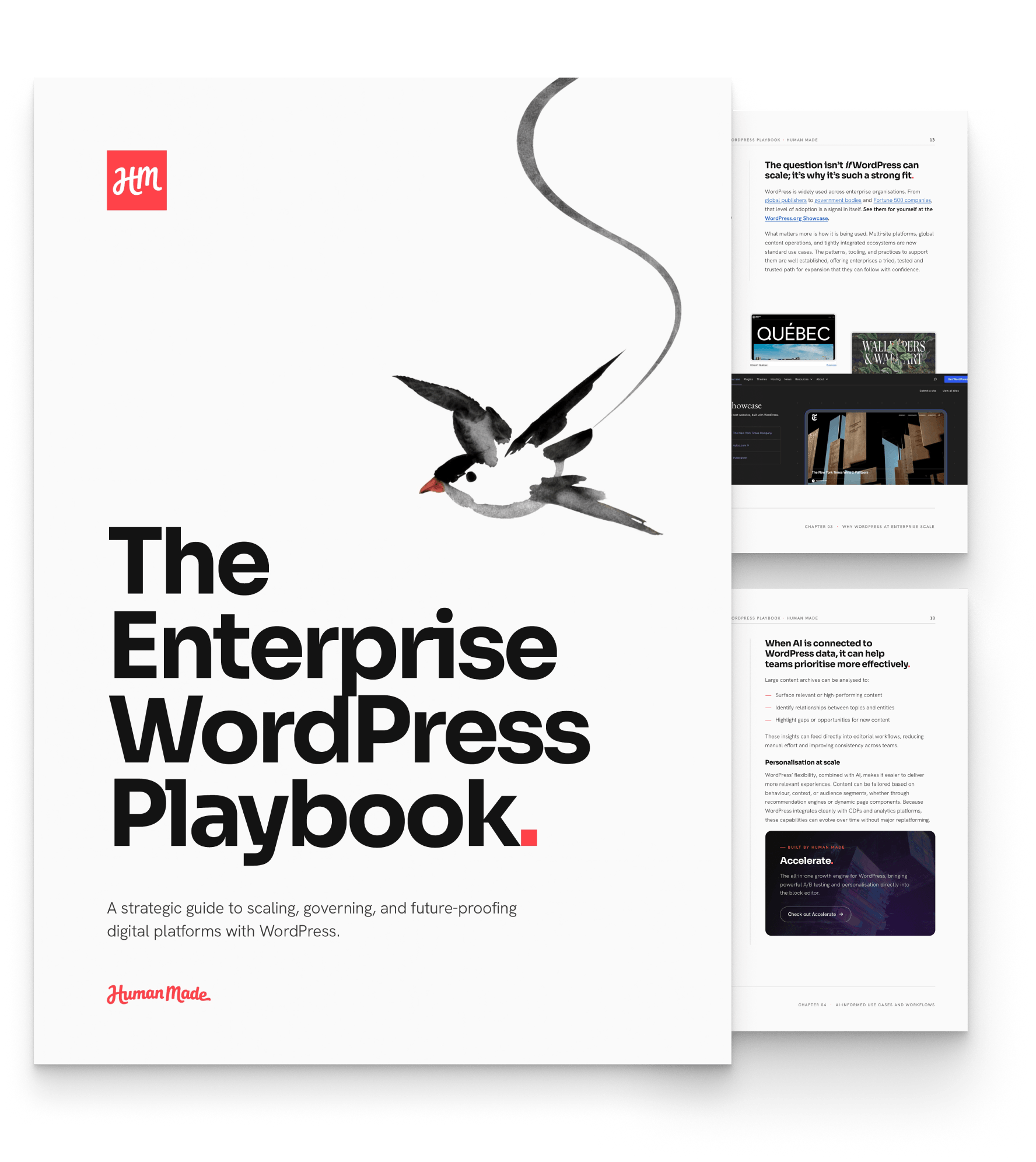
Download The Enterprise WordPress Playbook to explore platform strategy, governance, composable architecture, AI adoption, and the factors that shape long-term enterprise platform success.
WordPress for Enterprise#Enterprise #CMS #Costs #Total #Cost #Ownership #Means1782468412
