

Subscribe to Updates

    Get the latest creative news from FooBar about art, design and business.

    What's Hot

    Tesla reportedly might sell its China business ahead of a SpaceX merger

    July 31, 2026

    Steelseries Arctis Nova Pro Omni Review: For Multisystem Gamers

    July 31, 2026

    SJY Zeph Open-Back Headphones Review: Music Through Magnets

    July 31, 2026
    Facebook Twitter Instagram
    • Tech
    • Gadgets
    • Spotlight
    • Gaming
    Facebook Twitter Instagram
    iGadgets TechiGadgets Tech
    Subscribe
    • Home
    • Gadgets
    • Insights
    • Apps

      Tesla reportedly might sell its China business ahead of a SpaceX merger

      July 31, 2026

      Repeat founder Ryan Williams raises $10M seed for an AI startup for private credit managers

      July 31, 2026

      Nscale buys Anyscale as it seeks to own more of the AI compute stack

      July 31, 2026

      Netflix lands global streaming deal for ‘The Walking Dead’

      July 31, 2026

      Meta says AI is making it easier to build new apps — and more are coming

      July 31, 2026
    • Gear
    • Mobiles
      1. Tech
      2. Gadgets
      3. Insights
      4. View All

      Steelseries Arctis Nova Pro Omni Review: For Multisystem Gamers

      July 31, 2026

      SJY Zeph Open-Back Headphones Review: Music Through Magnets

      July 31, 2026

      6 Best Phones With Headphone Jacks (2026), Tested and Reviewed

      July 31, 2026

      Daisy One Review: Comfy and Tactile Headphones

      July 31, 2026

      March Update May Have Weakened The Haptics For Pixel 6 Users

      April 2, 2022

      Project 'Diamond' Is The Galaxy S23, Not A Rollable Smartphone

      April 2, 2022

      The At A Glance Widget Is More Useful After March Update

      April 2, 2022

      Pre-Order The OnePlus 10 Pro For Just $1 In The US

      April 2, 2022

      Motorola Edge+ Review: It Checks A Lot Of Boxes

      April 2, 2022

      This Smartphone Concept Design Is Different… In A Good Way

      April 2, 2022

      Twitter Just Made Searching Your Direct Messages Better

      April 2, 2022

      That Netflix Price Hike Is Starting To Take Place

      April 2, 2022

      Latest Huawei Mobiles P50 and P50 Pro Feature Kirin Chips

      January 15, 2021

      Samsung Galaxy M62 Benchmarked with Galaxy Note10’s Chipset

      January 15, 2021
      9.1

      Review: T-Mobile Winning 5G Race Around the World

      January 15, 2021
      8.9

      Samsung Galaxy S21 Ultra Review: the New King of Android Phones

      January 15, 2021
    • Computing
    iGadgets TechiGadgets Tech
    Home»Tech»British Space Startup Launches Longevity Lab Into Orbit
    Tech

    British Space Startup Launches Longevity Lab Into Orbit

    adminBy adminJuly 7, 2026No Comments3 Mins Read
    Facebook Twitter Pinterest LinkedIn Tumblr Email
    British Space Startup Launches Longevity Lab Into Orbit
    Share
    Facebook Twitter LinkedIn Pinterest Email

    Space is becoming the next frontier in longevity research.

    A British startup just launched self-run chemical experiments into orbit, in the hopes zero-gravity data might shine a light on a group of disease-causing proteins too difficult to study on Earth. But first they need to check their autonomous laboratory will work in space.

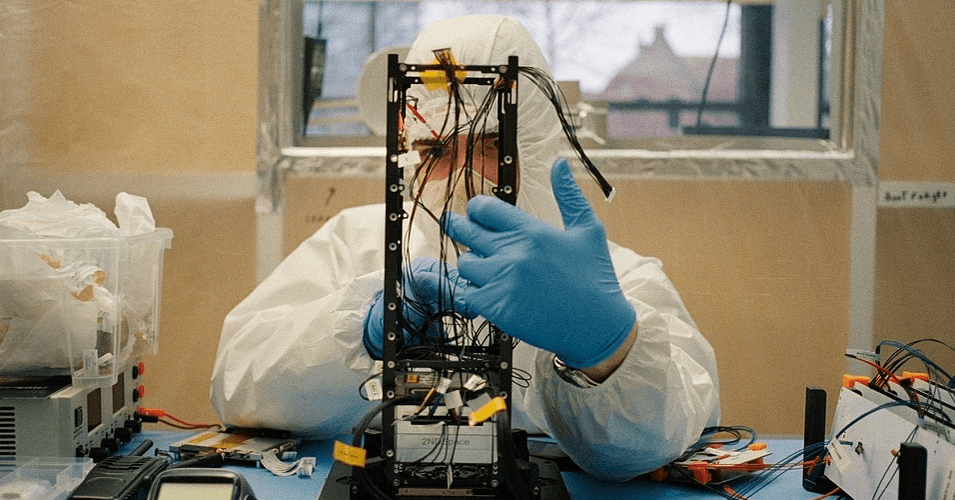
    Mass Balance’s grapefruit-sized apparatus containing chemicals, sensors and control elements to keep the chemicals functioning launched on a SpaceX transporter on Tuesday morning. Contained in a 10 centimeter (4 inch) pod built by Austrian company Tumbleweed, the experiment will orbit the Earth for a couple of months, automatically measuring and beaming back down data about how the live cells grow, react, and function under weak gravity.

    It’s the first test of a system that the company hopes could yield high-quality data unobtainable on Earth, where stronger gravity introduces effects like convection, through which heat flows, and sedimentation, where heavier compounds sink, muddying data collection.

    ‘“When you take away gravity, a lot of weird and wonderful things happen, some of which will be very valuable for life sciences and pharma,” Mass Balance co-founder and chief executive officer Toby Call says in an interview. “It sounds wild today, but the goal is really to make space boring, reliable, and just another research environment.”

    This research environment could be crucial to imaging disordered proteins, he says, which are responsible for age-related diseases including Alzheimer’s, Parkinson’s, and certain cancers.

    On Earth, these proteins constantly change shape, making them difficult to image. That creates a gap in training data for life sciences models like Google’s AlphaFold, leaving them unable to predict how disordered proteins will behave—and respond to medicines.

    But in space, scientists believe some disease-driving disordered proteins may be easier to study and analyze. Call plans to generate data by running tests on disordered proteins under micro-gravity and use it to train an AI model adapter which fills in the gaps – with the model, data licensing, and data access driving revenue for his firm.

    For now though, the company is just testing its operating system and data capture. Tuesday’s mission will take an industrial biocatalyst into space, which will break another chemical compound down. The platform will monitor the process using light to confirm that the chemical reaction takes place as planned.

    Several other biotech startups are attempting to develop orbiting laboratories. In May, British firm BioOrbit launched a test unit growing ultra-pure, stable crystals which can be turned into injectable cancer medications, while American-owned Varda Space Industries is similarly working on processing pharmaceuticals under microgravity. Unlike these two firms, Mass Balance is not trying to bring its system back to Earth intact, which will spare it some of the larger engineering challenges of ensuring it can withstand the extreme heat and stress satellites experience when returning through the Earth’s atmosphere.

    “Microgravity is a new tool that is under-exploited,” Call says.

    Science,Science / Space,Science! In Space!space,science experiments,longevity,cancer,artificial intelligence,spacex#British #Space #Startup #Launches #Longevity #Lab #Orbit1783418411

    artificial intelligence British Cancer Lab Launches longevity orbit science experiments space SpaceX startup
    Share. Facebook Twitter Pinterest LinkedIn Tumblr Email
    admin
    • Website
    • Tumblr

    Related Posts

    Tesla reportedly might sell its China business ahead of a SpaceX merger

    July 31, 2026

    Steelseries Arctis Nova Pro Omni Review: For Multisystem Gamers

    July 31, 2026

    SJY Zeph Open-Back Headphones Review: Music Through Magnets

    July 31, 2026
    Add A Comment

    Leave A Reply Cancel Reply

    Editors Picks
    8.5

    Apple Planning Big Mac Redesign and Half-Sized Old Mac

    January 5, 2021

    Autonomous Driving Startup Attracts Chinese Investor

    January 5, 2021

    Onboard Cameras Allow Disabled Quadcopters to Fly

    January 5, 2021
    Top Reviews
    9.1

    Review: T-Mobile Winning 5G Race Around the World

    By admin
    8.9

    Xiaomi Mi 10: New Variant with Snapdragon 870 Review

    By admin
    8.9

    Samsung Galaxy S21 Ultra Review: the New King of Android Phones

    By admin
    Advertisement
    Demo
    iGadgets Tech
    Facebook Twitter Instagram Pinterest Vimeo YouTube
    • Home
    • Tech
    • Gadgets
    • Mobiles
    • Our Authors
    © 2026 ThemeSphere. Designed by WPfastworld.
    "korean kbj​ "korean bj "koreanbj​

    Type above and press Enter to search. Press Esc to cancel.