


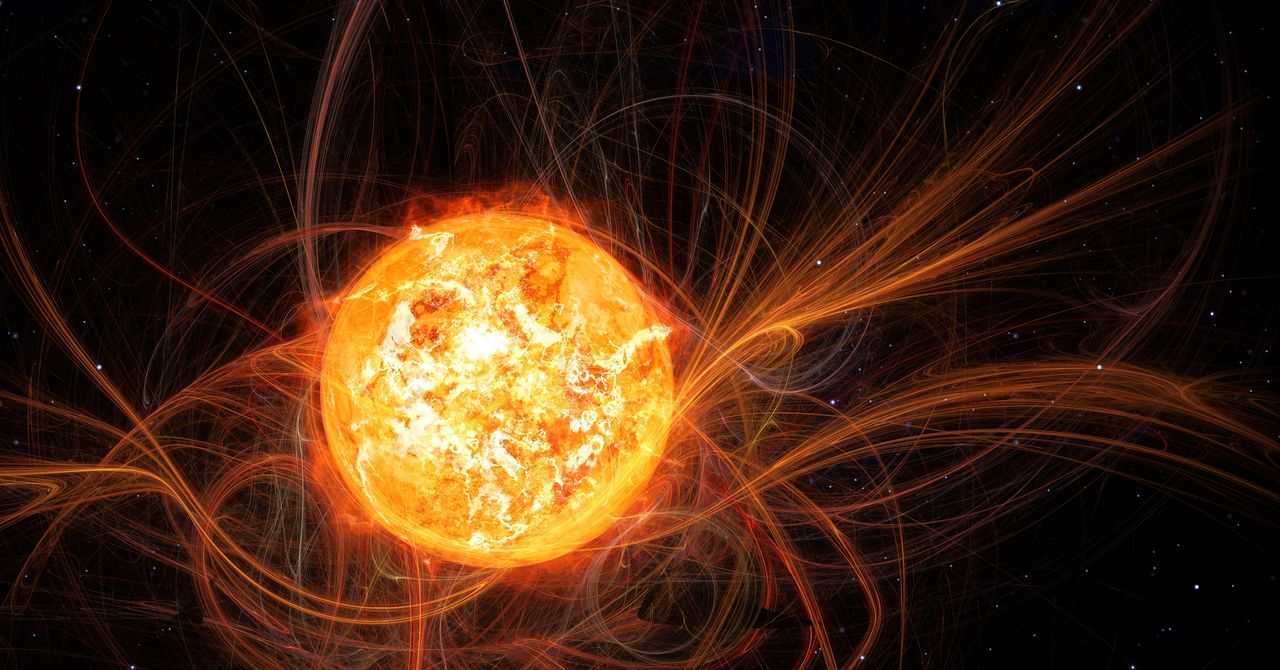
It’s well known that a solar storm, depending on its level of intensity, can affect the functioning of electrical grids, navigation systems, or satellite communications. The problem is that it’s unclear what would happen today if the intensity of a storm reached levels like those of the so-called Carrington Event in 1859, one of those extraordinarily rare phenomena that occur only once every thousand years. New research, though, suggests the impact might be even worse than scientists had thought.
Solar storms occur when the solar wind—a continuous stream of charged particles emitted by the sun—interacts with Earth’s magnetosphere. During the Carrington Event, telegraph communications collapsed across half the world, and the northern lights were visible throughout North America as far south as Cuba. In today’s world, strong solar storms can have wider-ranging effects and can even alter the upper atmosphere.
“Our planet’s magnetic field does a really great job of protecting us against many space weather effects and so they often just show up as glitches or beautiful aurora,” notes Maria Walach, a researcher at Lancaster University who collaborated on the study. “There are however extreme cases, where satellites unexpectedly fall back to Earth, or we lose communication and GPS signals.”
To estimate the intensity of the solar wind, researchers primarily use measurements taken by satellites located at the L1 Lagrange point, about 1.5 million kilometers from Earth. The problem is that those observations do not correspond exactly to the environment where the solar wind ultimately interacts with Earth’s magnetic field. A variable amount of time passes between the two points, and the solar plasma also changes during its journey.
The authors argue that this uncertainty, far from being mere experimental noise, introduces a systematic bias into the analysis of the data.
Solar Statistics
The central point of the study lies in a well-known statistical phenomenon called regression toward the mean. In simple terms, when a measurement is extraordinarily high, the true value it is trying to represent is, on average, less extreme. This happens because random uncertainties can occasionally exaggerate an observation.
In the case of the solar wind, an exceptionally intense measurement made at L1 probably corresponds to a somewhat less intense solar wind by the time it reaches the region where it actually interacts with the magnetosphere. If scientists directly relate that extreme measurement to Earth’s observed response, the effect will appear insignificant relative to such a large stimulus. Repeated thousands of times, this effect creates the false impression that the magnetosphere stops responding as the intensity of the solar wind increases.
What has happened is that, for years, scientists have believed that there is a natural limit to the intensity with which Earth responds to the most extreme solar storms. According to that idea, when the solar wind reaches very high values, Earth’s magnetic field stops reacting proportionally, and its response enters a kind of “saturation.” However, this new study suggests that perhaps that limit never existed. What appeared to be a physical phenomenon could, in reality, be an illusion caused by the way the measurements are analyzed.
To test this hypothesis, the researchers developed a statistical model that incorporates the main sources of uncertainty: variations in the time it takes the solar wind to reach Earth and the random changes it undergoes during that journey. The model reproduces with remarkable accuracy the same “saturation” curve observed in more than 25 years of data, without the need to invoke any physical mechanism limiting Earth’s response.
They then applied a technique known as regression calibration, which mathematically corrects the bias introduced by measurement uncertainties. After that correction, the supposed saturation almost completely disappears. The relationship between solar wind intensity and the geomagnetic response becomes essentially linear again, at least within the range for which sufficient recorded observations exist—more than a million of them, in fact.
No Limit
What are the consequences of these results, as published in the journal Nature? If Earth’s response continues to grow proportionally during catastrophic events, an extreme solar storm such as the Carrington Event could be considerably more dangerous than previously thought. The authors estimate that, for very high solar wind values, the geomagnetic impact could be approximately twice that calculated by traditional models.
“If there is no upper limit to our planet’s response to the solar wind, modeling for extreme cases needs to take this into account and we should be vigilant of space weather effects.” said Walach in the press release. “Fortunately, these very extreme cases are rare, but this also means we have limited data to work with and only time will tell what happens at the very extreme, one-in-a-thousand-year kind of event.”
Indeed, the study acknowledges that limitation: There are still very few records of the most extreme episodes. For that reason, the researchers do not claim that saturation is impossible. Rather, they argue that the available data do not provide convincing statistical evidence for its existence.
This story originally appeared on WIRED en Español and has been translated from Spanish.
Science,Science / Space,Sun of All Fearsspace,astronomy,sun,solar energy#Extreme #Solar #Storm #Devastating #Previously #Imagined1785231063
