


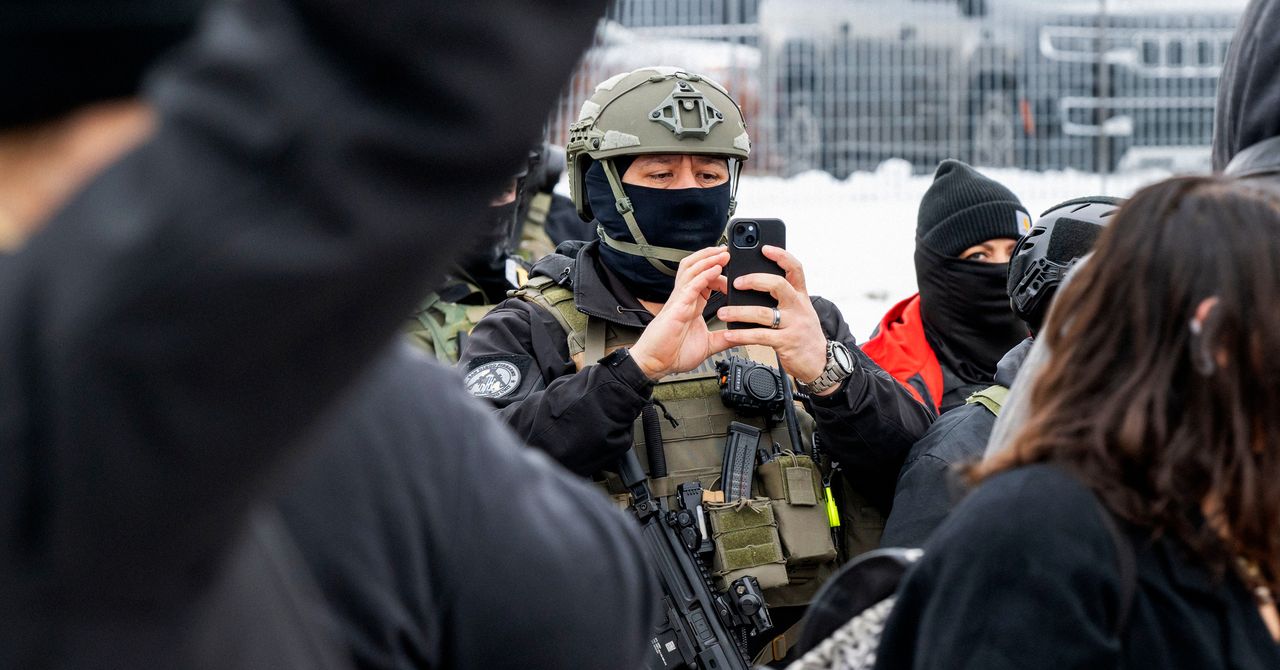
The face-recognition app Mobile Fortify, now used by United States immigration agents in towns and cities across the US, is not designed to reliably identify people in the streets and was deployed without the scrutiny that has historically governed the rollout of technologies that impact people’s privacy, according to records reviewed by WIRED.
The Department of Homeland Security launched Mobile Fortify in the spring of 2025 to “determine or verify” the identities of individuals stopped or detained by DHS officers during federal operations, records show. DHS explicitly linked the rollout to an executive order, signed by President Donald Trump on his first day in office, which called for a “total and efficient” crackdown on undocumented immigrants through the use of expedited removals, expanded detention, and funding pressure on states, among other tactics.
Despite DHS repeatedly framing Mobile Fortify as a tool for identifying people through facial recognition, however, the app does not actually “verify” the identities of people stopped by federal immigration agents—a well-known limitation of the technology and a function of how Mobile Fortify is designed and used.
“Every manufacturer of this technology, every police department with a policy makes very clear that face recognition technology is not capable of providing a positive identification, that it makes mistakes, and that it’s only for generating leads,” says Nathan Wessler, deputy director of the American Civil Liberties Union’s Speech, Privacy, and Technology Project.
Records reviewed by WIRED also show that DHS’s hasty approval of Fortify last May was enabled by dismantling centralized privacy reviews and quietly removing department-wide limits on facial recognition—changes overseen by a former Heritage Foundation lawyer and Project 2025 contributor, who now serves in a senior DHS privacy role.
DHS—which has declined to detail the methods and tools that agents are using, despite repeated calls from oversight officials and nonprofit privacy watchdogs—has used Mobile Fortify to scan the faces not only of “targeted individuals,” but also people later confirmed to be US citizens and others who were observing or protesting enforcement activity.
Reporting has documented federal agents telling citizens they were being recorded with facial recognition and that their faces would be added to a database without consent. Other accounts describe agents treating accent, perceived ethnicity, or skin color as a basis to escalate encounters—then using face scanning as the next step once a stop is underway. Together, the cases illustrate a broader shift in DHS enforcement toward low-level street encounters followed by biometric capture like face scans, with limited transparency around the tool’s operation and use.
Fortify’s technology mobilizes facial capture hundreds of miles from the US border, allowing DHS to generate nonconsensual face prints of people who, “it is conceivable,” DHS’s Privacy Office says, are “US citizens or lawful permanent residents.” As with the circumstances surrounding its deployment to agents with Customs and Border Protection and Immigration and Customs Enforcement, Fortify’s functionality is visible mainly today through court filings and sworn agent testimony.
In a federal lawsuit this month, attorneys for the State of Illinois and the City of Chicago said the app had been used “in the field over 100,000 times” since launch.
In Oregon testimony last year, an agent said two photos of a woman in custody taken with his face-recognition app produced different identities. The woman was handcuffed and looking downward, the agent said, prompting him to physically reposition her to obtain the first image. The movement, he testified, caused her to yelp in pain. The app returned a name and photo of a woman named Maria; a match that the agent rated “a maybe.”
Agents called out the name, “Maria, Maria,” to gauge her reaction. When she failed to respond, they took another photo. The agent testified the second result was “possible,” but added, “I don’t know.” Asked what supported probable cause, the agent cited the woman speaking Spanish, her presence with others who appeared to be noncitizens, and a “possible match” via facial recognition. The agent testified that the app did not indicate how confident the system was in a match. “It’s just an image, your honor. You have to look at the eyes and the nose and the mouth and the lips.”
Security,Security / National Security,Security / Privacy,Security / Security News,Politics / Policy,ID, Pleaseimmigration,immigration and customs enforcement,department of homeland security,privacy,crime,police,surveillance,artificial intelligence,face recognition,freedom of information act#ICE #CBPs #FaceRecognition #App #Verify #People1770334653
