


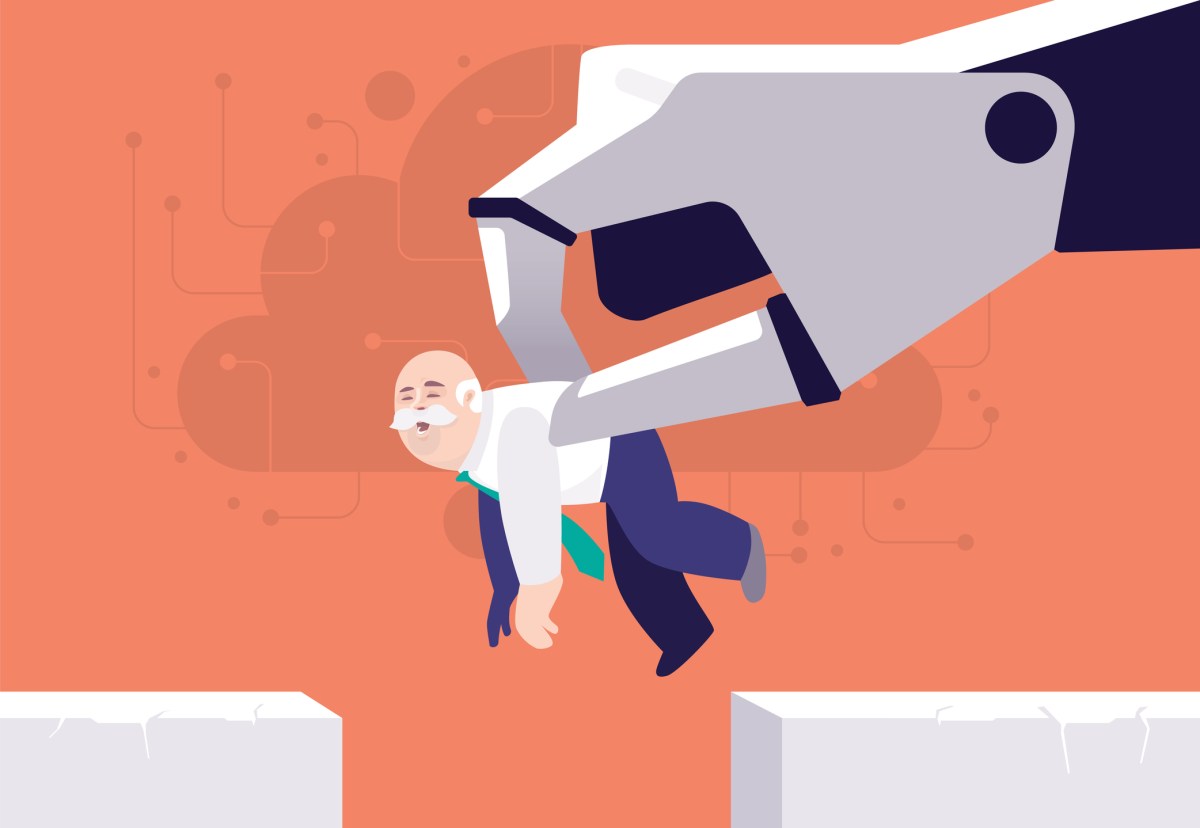
One day not long ago, a founder texted his investor with an update: he was replacing his entire customer service team with Claude Code, an AI tool that can write and deploy software on its own. To Lex Zhao, an investor at One Way Ventures, the message indicated something bigger — the moment when companies like Salesforce stopped being the automatic default.
“The barriers to entry for creating software are so low now thanks to coding agents, that the build versus buy decision is shifting toward build in so many cases,” Zhao told TechCrunch.
The build versus buy shift is only part of the problem. The whole idea of using AI agents instead of people to perform work throws into question the SaaS business model itself. SaaS companies currently price their software per seat — meaning by how many employees log in to use it. “SaaS has long been regarded as one of the most attractive business models due to its highly predictable recurring revenue, immense scalability, and 70-90% gross margins,” Abdul Abdirahman, an investor at the venture firm F-Prime, told TechCrunch.
When one, or a handful, of AI agents can do that work — when employees simply ask their AI of choice to pull the data from the system — that per-seat model starts to break down.
The rapid pace of AI development also means that new tools, like Claude Code or OpenAI’s Codex, can replicate not just the core functions of SaaS products but also the add-on tools a SaaS vendor would sell to grow revenue from existing customers.
On top of that, customers now have the ultimate contract negotiation tool in their pockets: If they don’t like a SaaS vendor’s prices, they can, more easily than ever before, build their own alternative. “Even if they do not take the build route, this creates downward pressure on contracts that SaaS vendors can secure during renewals,” Abdirahman continued.
We saw this as early as late 2024, when Klarna announced that it had ditched Salesforce’s flagship CRM product in favor of its own homegrown AI system. The realization that a growing number of other companies can do the same is spooking public markets, where the stock prices of SaaS giants like Salesforce and Workday have been sliding. In early February, an investor sell-off wiped nearly $1 trillion in market value from software and services stocks, followed by another billion later in the month.
Techcrunch event
San Francisco, CA
|
October 13-15, 2026
Experts are calling it the SaaSpocalypse, with one analyst dubbing it FOBO investing — or fear of becoming obsolete.
Yet the venture investors TechCrunch spoke with believe such fears are only temporary. “This isn’t the death of SaaS,” Aaron Holiday, a managing partner at 645 Ventures, told TechCrunch. Rather, it’s the beginning of an old snake shedding its skin, he said.
Move fast, break SaaS
The public market pattern is best illustrated through Anthropic’s recent product launches. The company released Claude Code for cybersecurity, and related stocks dropped. It released legal tools in Claude Cowork AI, and the stock price of the iShares Expanded Tech-Software Sector ETF — a basket of publicly traded software companies that includes firms like LegalZoom and RELX — also dropped.
In some ways, this was expected, as SaaS companies had long been overvalued, investors said. It also doesn’t help that these companies did the bulk of their growing during the zero-interest-rate era, which has since ended. The cost of doing business rises when the cost of borrowing money increases.
Public market investors typically price SaaS companies by estimating future revenue. But there is no telling whether in one year or five years anyone will be using SaaS products to the extent they once did. That’s why every time a new advanced AI tool launches, SaaS stocks feel a tremor.
“This may be the first time in history that the terminal value of software is being fundamentally questioned, materially reshaping how SaaS companies are underwritten going forward,” Abdirahman said.
That’s because slapping AI features on top of existing SaaS products may not be enough. A horde of AI-native startups is rising at a record pace, having completely redefined what it means to be a software company.
Software is now easier and cheaper to build, meaning it’s easier to replicate, Yoni Rechtman, a partner at Slow Ventures, told TechCrunch.
That’s good news for the next generation of startups, but bad news for the incumbents that spent years building their tech stacks.
On the other hand, the market also lacks enough time and evidence to show that whatever new business model emerges the SaaS’s wake will be worthwhile. AI companies are sometimes pricing their models based on consumption, meaning customers pay based on how much AI they use, measured in tokens (which each model provider defines slightly differently).
Others are working on “outcome-based pricing,” where fees are charged based on how well the AI actually works. This, ironically, is the current approach of former Salesforce CEO Bret Taylor’s AI startup, Sierra, a quasi-Salesforce competitor that offers customer service agents.
The approach appears, so far, appears to be working. In November, Sierra hit $100 million in annual recurring revenue in less than two years.
There was once also the idea that cloud-based software like SaaS sells would never depreciate and that it could last for decades. This is still true in some ways compared to what came before — on-premises software, which companies had to install and maintain on their own servers.
But being in the cloud doesn’t protect SaaS vendors from an entirely new technology rising to compete: AI.
Investors are rightfully nervous as AI-native companies pop up, adapt, adopt, and build technology much faster than a traditional SaaS company can move. SaaS companies are, after all, themselves the incumbents, having replaced old-school on-premises vendors in the last era of disruption.
This SaaSpocalypse calls to mind that Taylor Swift lyric about what happens when “someone else lights up the room” because “people love an ingénue.”
“The most important thing to understand about the SaaS pullback is that it is simultaneously a real structural shift and potentially a market overreaction,” Abdirahman said, adding that investors typically “sell first and ask questions later.”
SaaS IPOs are on hold
Public-market SaaS companies aren’t the only ones feeling a chill from investors.
A Crunchbase report released Wednesday showed that, though the IPO market seems to be thawing for some sectors, there haven’t been — and aren’t expected to be — any venture-backed SaaS filings on the horizon.
Holiday said this may be because there is a lot of pressure on large, private, late-stage SaaS companies like Canva and Rippling given the persnickety IPO window, high expectations driven by AI advancements, and the unsteady stock price of already public SaaS companies.
Some of these companies, including mid-size SaaS companies, have even struggled to raise extension rounds in the private market, Holiday said, over the same fears public investors have.
“Nobody wants to be subjected to the volatility of public markets when sentiment can send companies into downward tailspins,” Rechtman said, adding he expects to see companies like these to stay private for much longer.
Meanwhile, the public market waits to get a good look at the finances of the first AI-native companies hoping to IPO. The scuttlebutt says that both OpenAI and Anthropic are contemplating IPOs, maybe even later this year.
The most likely outcome is something that weaves the old and the new together, as tech disruptions always have.
Holiday said most of the new features companies are toying with these days “won’t stick” and that enterprises will always need software that meets compliance regulations, supports audits, manages workflow, and offers durability.
“Durable shareholder value isn’t built on hype,” he continued. “It’s built on fundamentals, retention, margins, real budgets, and defensibility.”
Venture,AI,markets,SaaSmarkets,SaaS#SaaS #SaaS #Heres #whats #driving #SaaSpocalypse1772374992
