


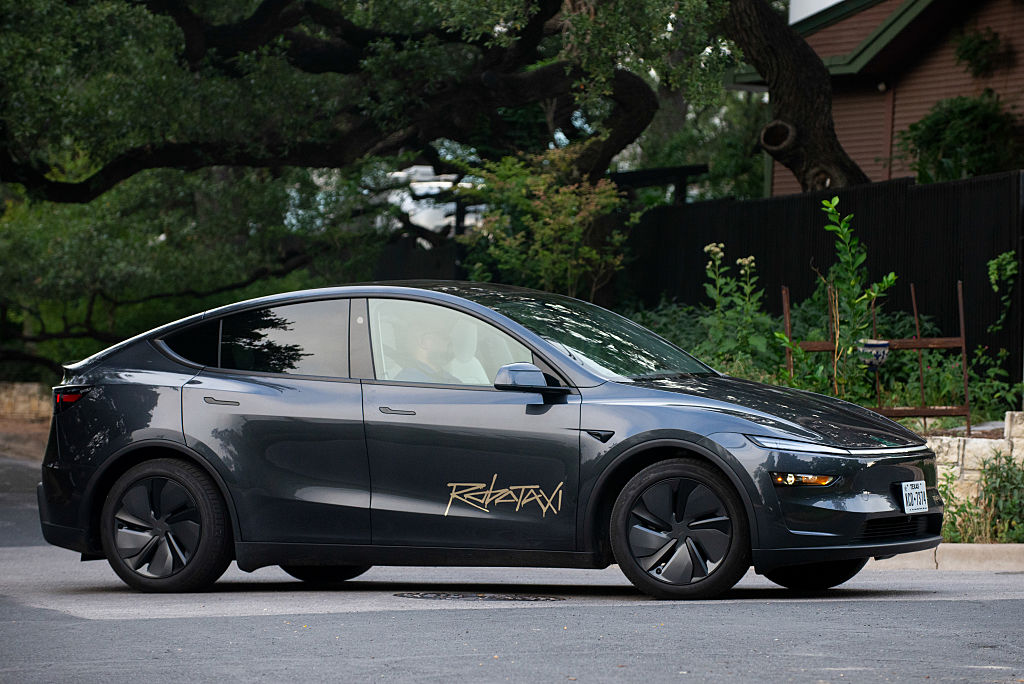
Tesla’s budding “Robotaxi” network drove fewer miles for paying customers in the second quarter than it did in the first, according to a chart the company released on Wednesday.
The quarter-over-quarter decline runs counter to Tesla’s rhetoric and actions in the past year. Tesla has staked much of its future on the idea of a massive, low-cost, cash-generating Robotaxi fleet — or going “balls to the wall for autonomy,” as CEO Elon Musk framed it in 2024. The quarterly step-down in Robotaxi miles also comes amid weakening profits in Tesla’s core businesses, which underperformed Wall Street’s expectations, according to figures released Wednesday. Tesla’s stock plunged more than 13% in early trading on Thursday.
At a passing glance, the chart appears to show steady growth in paid Robotaxi rides between August 2025 and June 2026. But the numbers displayed are cumulative, and when broken down by quarter, they show that Tesla’s Robotaxi fleet of Model Y SUVs carrying paying passengers covered around 1.1 million miles in the first quarter. That fell to roughly 700,000 miles in the second quarter, a decline of about 36%.
That’s despite the fact that the company has expanded its nascent operation to six cities across Texas and Florida, with a mix of unsupervised and supervised vehicles.

It’s likely Tesla is counting the paid miles driven in the San Francisco Bay Area, too, even though these branded Robotaxis don’t have the state-required permits to operate autonomously and also have a safety driver behind the wheel. Tesla has referred to that operation as part of its “Robotaxi coverage.”
The decline in miles driven also comes as Tesla made a striking admission on a conference call Wednesday about its second-quarter results. In response to a question about how slowly Tesla is scaling the Robotaxi service, Musk said the company needs to “accumulate driving data that is specific to the Cybercab” — the company’s gold, purpose-built, two-seater sedan that is expected to make up the bulk of its autonomous vehicle fleet — “before we can put a lot of them on the road.”
“Unlike, say, Model 3, Model Y, and our other vehicles where we’ve got a lot of vehicles on the road, millions of vehicles on the road, we don’t have that for Cybercab. So we actually have to accumulate miles with Cybercabs that are retrofitted with steering wheels and acceleration and braking pedals, that kind of thing, to calibrate to the Cybercab chassis,” he said. “As we are confident about that, the number of Cybercabs in cities will increase dramatically.”
This represents something of a break from claims the company has made for years about how its fleet of nearly 10 million customer cars has been silently collecting data in the background to train future robotaxis (in addition to training the driver assistance software for consumers, which Tesla calls Full Self-Driving).
On the call, Tesla executives framed the slow progress as a matter of being cautious about safety.
“Our goals are very ambitious for Robotaxi, but we do need to be cautious about causing any accidents or causing any harm to anyone,” Musk said.
He then said he doesn’t want Tesla Robotaxis causing accidents because he thinks bad media coverage could lead to a regulatory crackdown.
“Although there are, I think, 30 to 40,000 automotive deaths per year in the United States alone, most of those do not generate any press, you don’t really read about almost any of those. But if we injure even one person, it will be worldwide headline news, and regulators will immediately clamp down on our activities,” he said.
Ashok Elluswamy, Tesla’s VP of AI, boasted that Tesla’s Robotaxis have had “zero notable incidents” while driving “more than 380,000 miles” without a safety operator onboard. He did not define what the company considers “notable incidents,” though he claimed that “any reports have been of other actors impacting us when we were stationary.”
Tesla has reported 22 crashes to the National Highway Traffic Safety Administration in the year since it started trialing its Robotaxi service. While most of them involve other cars crashing into Tesla’s Robotaxis, the company has reported three crashes caused by its teleoperators moving the vehicles remotely, and multiple instances of the cars hitting objects at low speeds including curbs, utility poles, and a tow truck’s bed.
This represents another narrative change for the company. Tesla spent years claiming that the largest hurdle to full-scale Robotaxi deployment was regulatory in nature — though the company never really specified what those prohibitive regulations were.
Now the company says proving safety is all that’s holding Robotaxis back. And although it is still in the very early stages, Tesla still chose this moment to take a victory lap about its decision to build an autonomy stack that doesn’t use radar or lidar sensors, like industry leader Waymo.
“Historically, the so-called experts have always claimed that you need lidars, radars, HD maps, and the entire kitchen sink to drive safely. Here, we show that such is not true. You can have safe, comfortable, and affordable autonomy with just cameras,” Elluswamy said.
Both Musk and Elluswamy also promised growth is coming. They noted that the number of unsupervised miles traveled has grown roughly 10% every week since Tesla started offering them at the end of last year.
“We’ll continue to scale, I think, very, very rapidly,” Musk said.
When you purchase through links in our articles, we may earn a small commission. This doesn’t affect our editorial independence.
Transportation,Elon Musk,robotaxis,TeslaElon Musk,robotaxis,Tesla#Teslas #robotaxis #moving #reverse1784874653
