


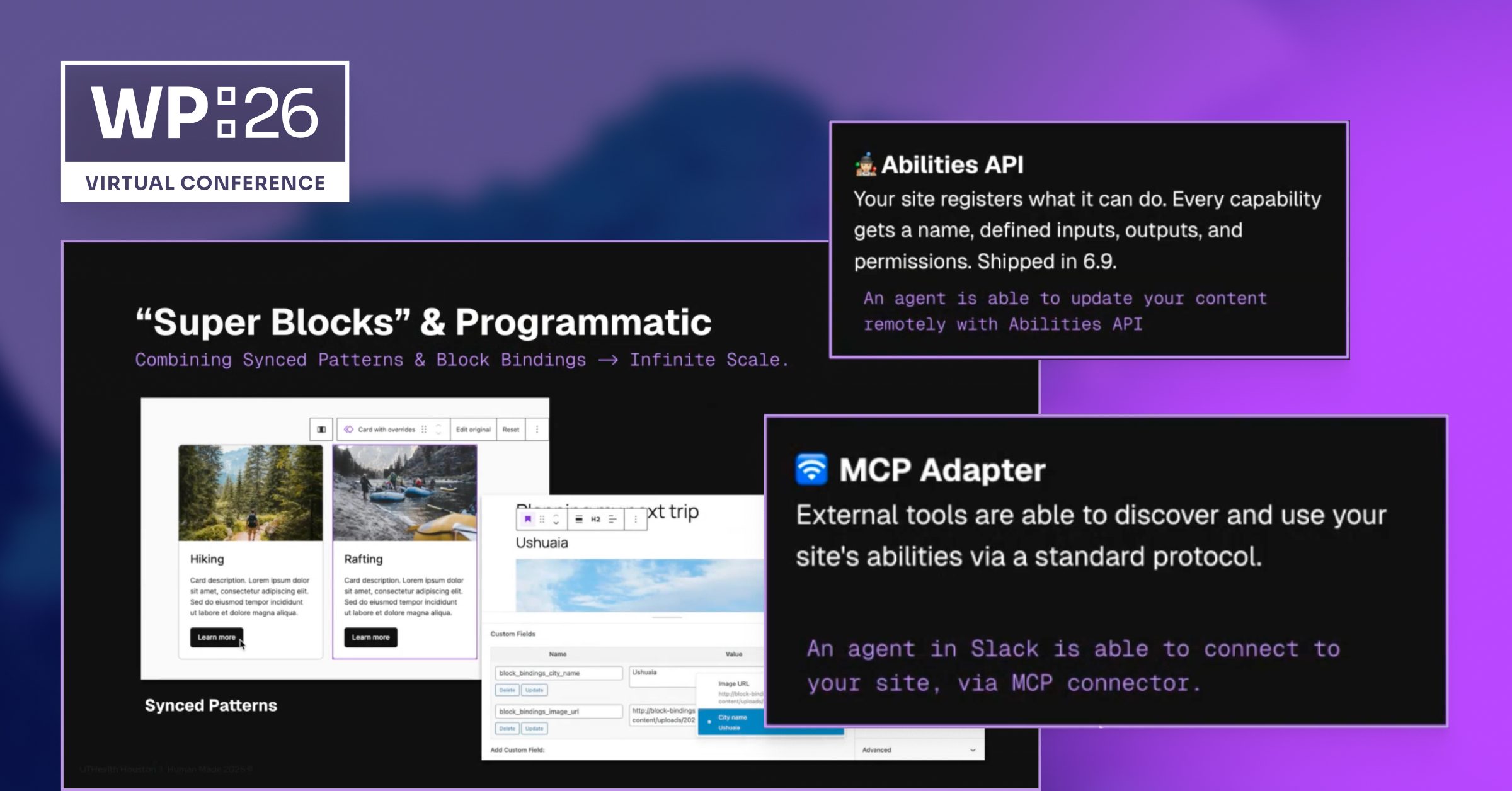
At WP:26, Human Made’s virtual event exploring the future of WordPress, we brought together technologists, publishers, and platform leaders to discuss one big question:
What patterns are emerging that will shape WordPress in 2026 and beyond?
Across a day of talks and conversations, speakers explored how AI, accessibility, enterprise publishing, and evolving web standards are reshaping the role of a CMS.
To open the event, Human Made’s CGO and Partner Noel Tock set the tone with a provocative idea:
What happens when software agents start interacting with websites as much as people do?
It’s a question that sits right at the centre of how the web is changing. AI systems are already summarising content, generating answers, and navigating websites programmatically. The next step is systems that don’t just read the web, but act on it.
And when that happens, the role of a CMS starts to look very different.
The web is becoming machine-operable
For most of the web’s history, websites have been designed primarily for human interaction. People visit a page, read content, click buttons, and navigate between sections.
But increasingly, machines are doing the same things.
Search engines have been crawling and interpreting websites for years. Now AI assistants and software agents are beginning to go further, understanding context, extracting information, and triggering workflows across systems.
As Noel put it during the talk:
“The web is shifting from something humans browse to something agents can act on.”
That shift has significant implications for how digital platforms are designed.
If agents can interact with websites directly, the web becomes less like a collection of documents and more like a network of programmable interfaces.
Rethinking what a CMS actually does
This is where the conversation gets interesting for agentic WordPress.
Traditionally, a CMS has been thought of as publishing infrastructure. A system for managing content, rendering pages, and delivering experiences to users.
But in an agent-driven environment, a CMS becomes something more powerful: a platform for orchestrating workflows between systems, people, and AI agents.
Content becomes structured data. Interfaces become programmable endpoints. Publishing workflows become automation pipelines.
That’s not a distant future scenario. In many organisations, it’s already starting to happen.
Why WordPress is well positioned for an agentic future
One of the most compelling ideas in Noel’s keynote was that WordPress may actually be unusually well suited to this transition.
Not because it was designed for AI agents — it wasn’t.
But because of the way the platform has evolved over time.
WordPress already has many of the characteristics needed for this next, agentic phase of the web:
- Open APIs that allow systems to interact with content programmatically
- Extensibility through plugins and custom development
- Flexible architectures that support headless, hybrid, and full-stack approaches
- A large ecosystem constantly experimenting with new patterns
In other words, the platform has the structural flexibility needed to adapt as the web changes.
That adaptability has been one of WordPress’s quiet strengths for more than two decades.
Open ecosystems move faster
Another thread running through the session was the role of openness.
When technology shifts quickly, proprietary systems often struggle to keep up. Innovation tends to happen faster in open ecosystems where developers can experiment, integrate new tools, and build on top of shared infrastructure.
We’re already seeing that pattern play out across the AI landscape itself, where many of the most influential tools and frameworks are emerging from open communities.
WordPress fits naturally into that model.
Its openness allows teams to integrate new AI capabilities, experiment with agent-based workflows, and adapt their platforms without waiting for a vendor roadmap to catch up.
From publishing system to programmable platform
If there was one idea that framed the rest of WP:26, it was this:
WordPress is evolving from publishing infrastructure into a programmable platform for intelligent workflows.
That doesn’t mean the fundamentals of content management go away. Publishing, editorial workflows, and content creation are still at the heart of the platform.
But the context around them is expanding.
Content isn’t just read by people anymore. It’s processed by systems.
Websites aren’t just visited. They’re queried and acted upon.
And platforms that can support that shift will play an important role in how the next generation of digital experiences are built.
A fitting start to WP:26
Noel’s keynote set the tone for the rest of the event.
Throughout the day, speakers explored related themes from different perspectives: how AI is changing search and discoverability, how accessibility overlaps with machine-readable content, and how enterprise organisations are adapting their WordPress platforms to support increasingly intelligent workflows.
In many ways, those conversations all traced back to the same underlying idea.
The web is changing.
And platforms like WordPress are evolving right alongside it.
Catch up on all the sessions from WP:26 and find out what the changing web means for enterprise teams.
WordPress for Enterprise#WordPress #agentic #platform1774031016
