


In the short term: An uncertain, Americanized World Cup calls for flexibility
Against this backdrop, the upcoming FIFA World Cup 26 tourney will call for both flexibility and sensitivity from brands.
We’re 100 days out from the biggest soccer tournament in history, with 48 teams competing across 80 matches, up from 64 matches in previous iterations. More than 40 of these will take place in U.S. venues, giving Fox huge sway over scheduling and primetime matches.
Bolstered by the Trump-era theatrics of the December draw, FIFA’s corruption allegations and potential ICE operations were already hanging over the event.
Now, an escalating U.S.–Iran conflict, stadium licensing debates, and as-of-yet unconfirmed ad formats, including commercialized hydration breaks, mean nothing is entirely predictable.
Remember when Budweiser, which paid $75 million to be the official beer of the World Cup in 2022, had to make a marketing U-turn after Qatari officials declared stadiums alcohol-free zones? Smart sponsors and marketers will be prepared for a similar level of chaos this time around.
Over the long term: LA28 cracks open new power dynamics
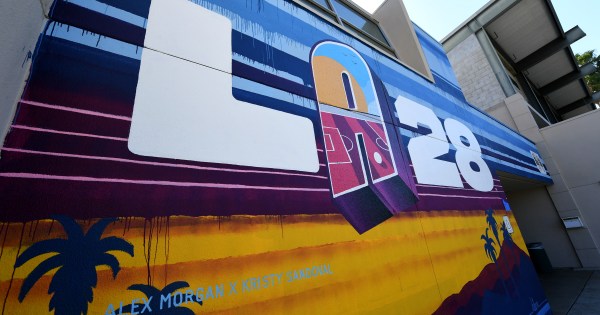
If we look further ahead to LA28, which NBCU is already promoting with help from Kate Hudson, another tug-of-war for influence lies ahead.
For the first time in the Games’ history, corporate sponsors are set to cover $2.5 billion of the privately-funded Games’ estimated $7.1 billion budget.
Those who have signed on to the highest domestic sponsorship tier so far include Delta, Honda, Starbucks, and Google. Airbnb, Coca-Cola, P&G, and Samsung are among the global partners.
The sponsorship parameters are changing, too. Intuit, for instance, is set to be one of the first companies ever allowed to keep a venue name for the Games, alongside Comcast Squash Center at Universal Studios and the Honda Center.
During past Games, in line with the International Olympic Committee’s (IOC) “clean venue” rules, existing corporate names for stadiums and arenas have not been used.
At LA28, the IOC is letting commercial influence spill beyond traditional ad slots. How far it will go remains unclear.
Judging by the controversy around LA28 chair Casey Wasserman’s historic email exchanges with Ghislaine Maxwell, and Hudson’s sun-soaked “California Dreamin’” cover, the next Olympics are shaping up as a full-on collision of entertainment and sport. It is Hollywood, after all.
Smart CMOs should start early on some “California Dreamin’” of their own, thinking about campaigns that can move fast and own the conversation.
But let’s get the World Cup out of the way first.

ADWEEK Advantage,General,Summer OlympicsSummer Olympics,ADWEEK Advantage,General#Race #World #Cup #LA28 #Expose #Sports #Power #Struggles1772637918
